
How much time does egg donation really take?
Egg donation typically takes about 2–3 months from start to finish, with the most active part occurring during the final 10–14 days. Most donors attend 6–8 clinic appointments total, including several brief early-morning visits and one day off for egg retrieval. With flexible scheduling and agency support, many donors continue working or attending school throughout the process.
For many potential egg donors, one of the biggest hesitations isn’t the medical process or the injections…it’s time. Between work, school, family responsibilities, and social commitments, it’s completely natural to wonder: How much time will egg donation really take, and can it realistically fit into my life?
If you’re asking that question, you’re not alone. Nearly every first-time donor wonders how disruptive the process might be before they start.
The reassuring truth is this: egg donation is a temporary, structured process, with long stretches of normal life in between appointments. Once donors understand how the timeline actually works, many are surprised by how manageable it feels.
Below, we’ll walk through what the time commitment truly looks like, how scheduling flexibility works, and how much time donors typically need to take off from work or school.
The Big Picture: What the Time Commitment Really Looks Like
When people hear “a few months,” it can sound like egg donation will take over their entire life. In reality, the process unfolds in clear phases, with only one short window that’s particularly hands-on.
Most donors experience:
> An overall timeline of about 2–3 months
> A busy period of about 10–14 days toward the end
> Roughly 6–8 in-person appointments total
> One full day off for egg retrieval, sometimes followed by a short recovery day
Rather than constant appointments, egg donation involves preparation, brief visits, and plenty of normal days in between.
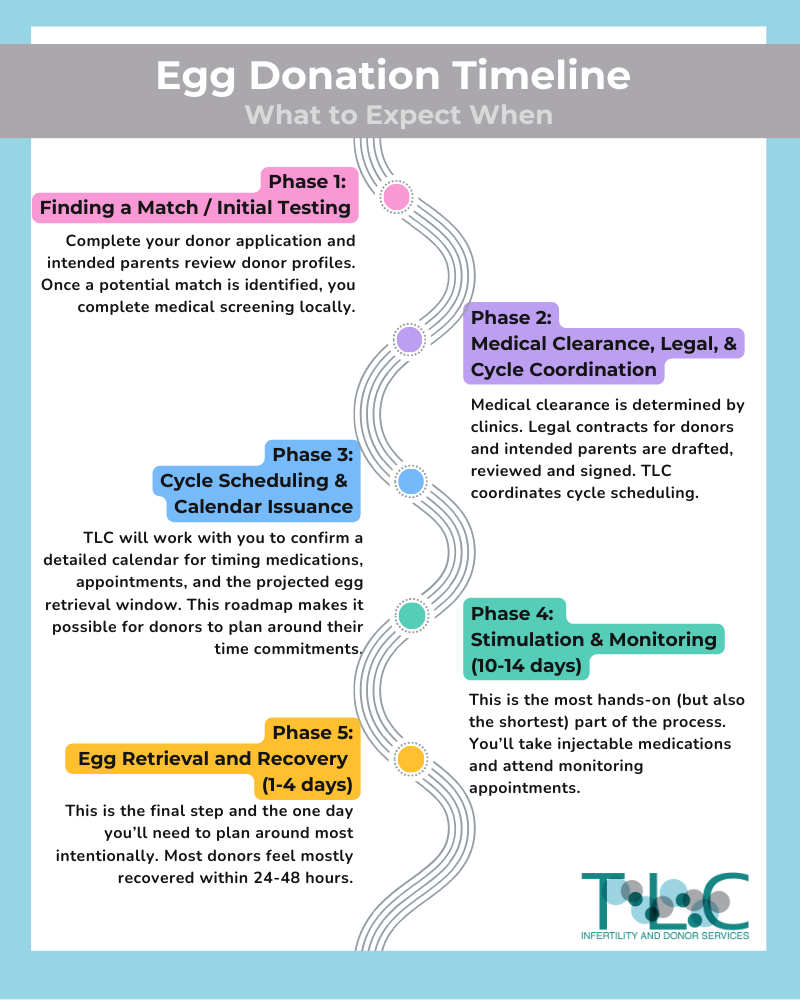
Phase 1: Finding a Match & Initial Testing (Weeks 1–4)
The first phase is focused on identifying the right match and completing the testing required to determine whether a cycle can move forward.
After completing your application and being accepted into the program, intended parents review donor profiles and select the donor they feel is the best fit. Once a potential match is identified, the donor completes local testing, which may include bloodwork (such as AMH testing), a genetic consultation, and a psychological evaluation if not already completed.
During this time, donors also attend medical screening at the fertility clinic where the cycle would take place. This screening typically includes lab work, an ultrasound, and a physical exam. These appointments are usually scheduled early in the morning and last one to two hours.
Screening results can take time to finalize, which is why this phase often feels light day-to-day, even though important steps are happening behind the scenes.
Phase 2: Medical Clearance, Legal, & Cycle Coordination
Once medical screening is complete, the process enters a waiting and coordination phase.
During this stage:
> Clinics review screening results and determine medical clearance for the cycle
> Legal contracts are drafted and reviewed by separate attorneys for the donor and intended parents
> TLC coordinates closely with the clinic and all parties to prepare for cycle scheduling
While this phase requires patience, it typically involves little to no in-person time for the donor. Donors are not expected to pause their normal routines, and no medications begin during this period.
Importantly, cycle timing is not finalized until legal agreements are fully executed and medical clearance is confirmed.
Phase 3: Cycle Scheduling & Calendar Issuance
After legal contracts are signed, TLC will work directly with the donor to identify a cycle start date that works best for her schedule.
Once dates are confirmed, the clinic issues a detailed calendar outlining:
> When medications will begin
> Monitoring appointment dates
> The projected egg retrieval window
At this point, donors have a clear, confirmed roadmap and can plan confidently around work, school, and personal commitments.

Phase 4: Stimulation & Monitoring (10–14 Days)
This is the most hands-on part of the process, and also the shortest.
For about 8–12 days (sometimes up to 14), donors take injectable medications that help the ovaries mature multiple eggs. Injections usually take five to ten minutes and quickly become part of a routine.
During this time, donors attend about 5–7 monitoring appointments, typically scheduled every two to three days. These visits usually last 30–60 minutes and include bloodwork and ultrasound monitoring.
Many clinics offer early-morning appointments, allowing donors to head straight to work or class afterward.
Phase 5: Egg Retrieval & Recovery (1–4 Days)
Egg retrieval is the final step in the donation process and the one day donors need to plan around most intentionally.
The procedure itself takes about 15–30 minutes and is performed under light (twilight) anesthesia. Donors usually spend a few hours at the clinic total and must arrange for a ride home. Retrieval day requires taking the day off.
Afterward, mild bloating, cramping, or fatigue is normal. Most donors feel significantly better within 24–48 hours, with full recovery typically within 2–4 days.
How Flexible Is Egg Donation Scheduling?
This is a common concern for first-time donors. Fertility clinics and agencies understand that donors have work, school, and personal responsibilities. Early-morning monitoring appointments are common, and donors receive advance notice whenever possible.
Agencies like TLC Donor Services play a key role in coordinating logistics, communicating expectations clearly, and advocating for donor-friendly scheduling throughout the process.
How Much Time Off Work or School Is Usually Needed?
For most donors:
> Egg retrieval day is required off
> An additional recovery day is optional, depending on how you feel
Monitoring appointments are rarely full-day commitments and are often scheduled outside normal work or class hours.
A Simple Egg Donation Timeline
> Weeks 1–4: Matching, local testing, and medical screening
> Weeks 4–6: Medical clearance, legal contracts, and cycle coordination
> Weeks 6–8: Medications, monitoring appointments, and retrieval
(Exact timing varies based on individual cycles and clinic protocols.)
The Bottom Line: Can Egg Donation Fit Into Your Life?
Egg donation requires planning, but it is temporary, intentional, and well-supported. Most donors find that once they understand the flow of the process, the time commitment feels far less disruptive than they expected.
If time has been your biggest question, know this: thousands of busy women successfully complete egg donation every year.
With the right guidance and transparency, egg donation can fit into your life, too.
Curious whether egg donation works with your schedule? TLC Donor Services is here to guide you, step by step, with clarity, care, and respect for your time.